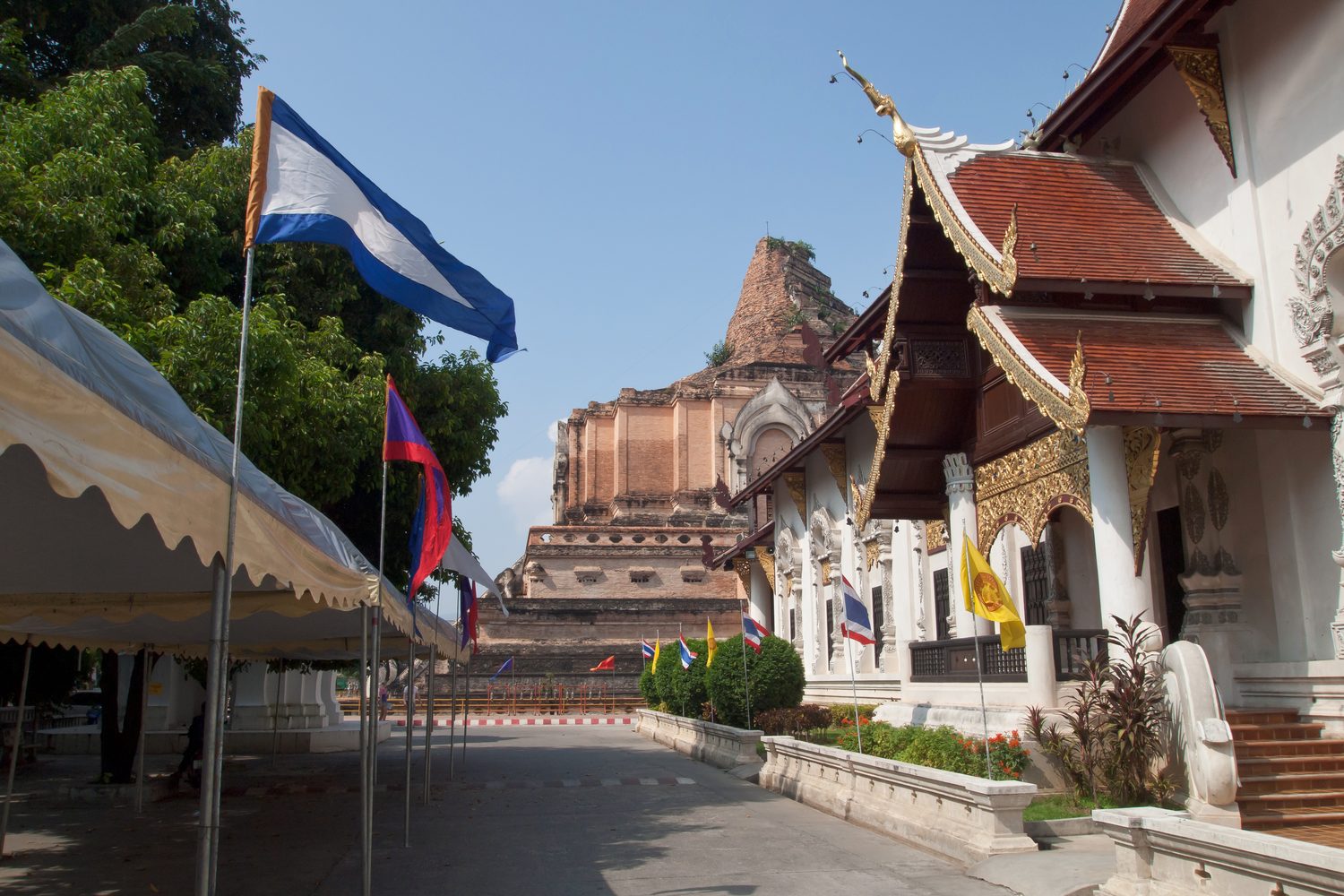
A chedi that was once the tallest in the Lanna kingdom, its top brought down by an earthquake nearly five centuries ago — yet the huge brick base still stands inside the moat. The one place where you can see Chiang Mai's city pillar and sit down for an easy conversation with a young monk.
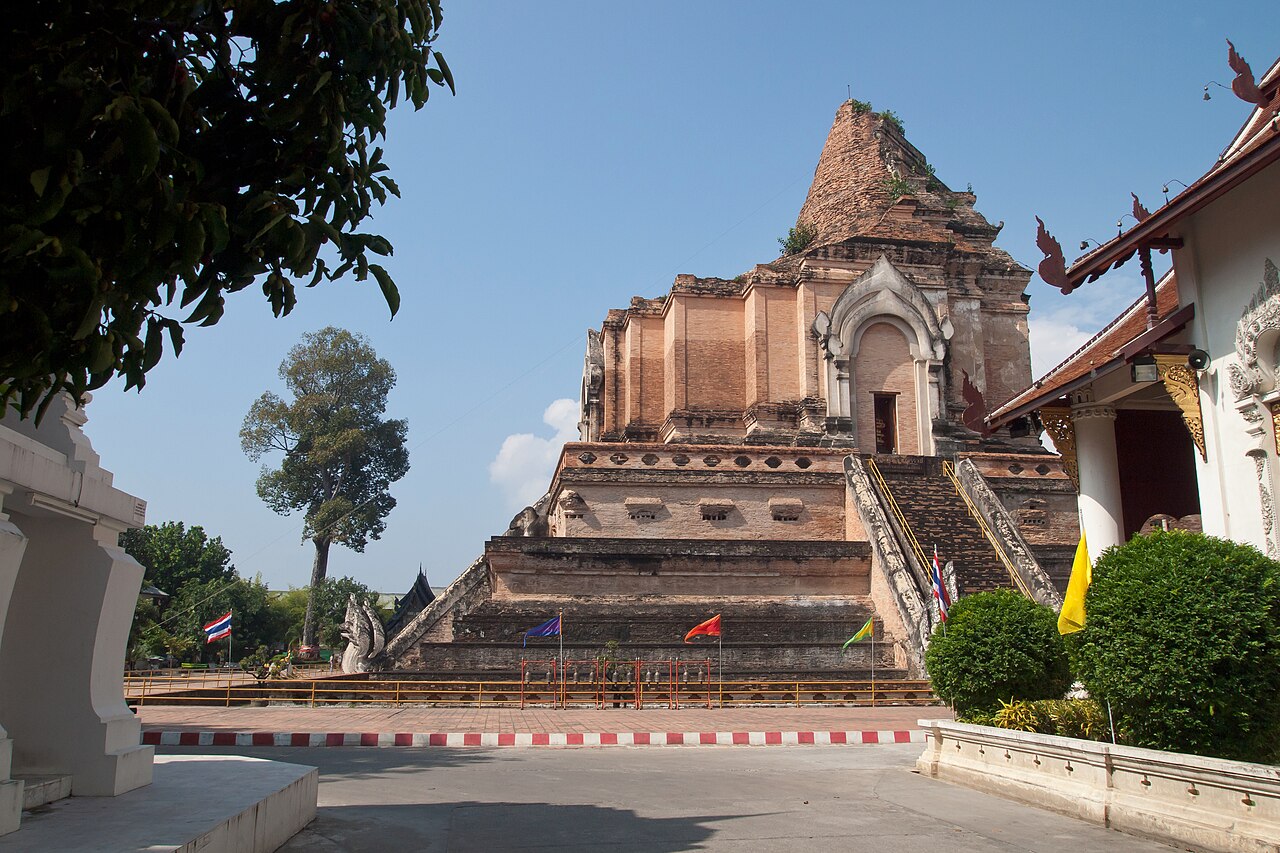
Walk into the temple grounds mid-morning, before the heat sets in, and look up: a reddish-brown mass of brick as tall as a several-storey building rises in front of you, the top half gone as if something snapped it off, leaving a broad square base ringed with naga staircases and stucco elephants. This is the Chedi Luang — the chedi that was once the tallest in the Lanna kingdom, and still one of the most powerful sights in Chiang Mai.
Wat Chedi Luang sits right in the centre of the moated Old City square. It was begun in the late 14th century under King Saen Muang Ma and finished by later rulers. The original chedi stood around 80 metres tall, the highest structure in Lanna at the time, until a major earthquake around 1545 brought down its upper section, leaving the roughly 60-metre ruin you see today — kept in that state ever since.
What makes this temple more than just an old ruin is that it gathers several things in one place. It holds the Inthakhin city pillar, the spiritual foundation stone that locals revere; it once housed the Emerald Buddha; and it runs a Monk Chat where visitors can genuinely sit and talk with young monks. One temple gives you history, faith and a living conversation all at once.
From the giant chedi to the city pillar and the Monk Chat — you can walk it all in about an hour.
The star of the temple is the colossal square brick chedi in the middle of the grounds. You can walk a full circle around the base and see naga staircases climbing each of the four sides, with stucco elephants emerging from one corner. The restored face carries niches and Buddha images, while the broken summit exposes the brick core within. Late-afternoon light on the old brick is especially good for photographs.
Within the grounds stands a small shrine housing the Inthakhin, the city pillar of Chiang Mai, which locals believe has anchored the fortune of the city since it was founded. Tall gum trees grow beside it, planted as its companions. Each year around late May into early June the Inthakhin festival fills the temple with people coming to make flower offerings and ask for blessings — visit then and you will see the temple at its most alive.
At the front of the temple is the large Lanna-style wihan, its roof stepping down in tiers and its gable carved and gilded. Inside sits a large principal Buddha image to pay respects to, and the entrance stairway is flanked by a fine pair of stucco nagas. Remember to remove your shoes and dress neatly before going in, as this is a space still in active religious use.
This is what sets Wat Chedi Luang apart — a corner where young monks and novices sit and talk openly with visitors. Most are student monks keen to practise their English, and you can ask about Buddhism, life in the temple or Lanna culture. It is a two-way exchange that leaves you understanding the place far better than walking around on your own. It is free; just sit politely and mind your manners.
The grounds around the chedi are shaded by old gum and bodhi trees, some of them centuries old, making this a comfortable spot to rest out of the sun while exploring the Old City. In the late afternoon the light softens and the courtyard turns quiet and calm. If you like atmospheric photos, this corner frames the chedi, the trees and the evening light together.
Wat Chedi Luang is a working temple, not just a monument, so you should keep your shoulders and knees covered, men and women alike. Avoid vests, shorts and short skirts. If you turn up underdressed, sarongs are usually available to borrow near the entrance. Take your shoes off to enter the wihan, and never point your feet towards a Buddha image.
One thing for women to know: by custom you should not stand close to or touch a monk directly. If you need to hand something to a monk, place it on a cloth or have a man pass it on. Keep your voice low and your manner calm inside the wihan.
The most comfortable times are early morning, around 7 to 9 am, when the air is still cool and the crowds are thin, or late afternoon, around 4 to 5.30 pm, when the sun has softened and golden light catches the brick of the chedi at its best. Avoid the middle of the day, when the sun is harsh and the open courtyard offers little shade.
The best season in Chiang Mai is November to February, when it is cool enough to walk all day. From February into April it is the dry burning season, when haze from agricultural fires can dull the air and the views, so if you have the choice, the cool season makes for far better Old City wandering.
The advantage of Wat Chedi Luang is that it sits right in the middle of the Old City. A few minutes' walk away is Wat Phra Singh, the other great temple of Chiang Mai, or step next door to Wat Phan Tao, an old teak wihan right beside it. All of them link up on a single easy walking route.
With half a day to spare, plan a temple walk through the Old City and finish with a café in the Nimman area or a stroll along the moat. On Sunday evenings the Walking Street market runs right past the temple, so timing it then lets you fold both the temple and the market into one trip.
The temple is on Phra Pokklao Road, right in the centre of the moated Old City square, and it is very easy to reach because almost everything here is within walking distance of one another. Chiang Mai has no urban rail, so getting around the Old City is best on foot, by bicycle, or by flagging a red songthaew truck or ordering a Grab.
All in or near the Old City — easy to combine in one day.