Home Osaka Japan Osaka Attractions About
Home  ›  Japan  ›  Osaka  ›  Getting Around
🚇 Getting Around Osaka · Trains, Cards, Passes · 2026

How do you get around Osaka?
Osaka Metro, the ICOCA card & the Amazing Pass

The red Midosuji line whisks you from Umeda down to Namba and Tennoji in minutes, the JR Osaka Loop Line circles the city much like Tokyo's Yamanote, and from here it's an easy hop by train to Kyoto, Nara and Kobe — this city is easier to get around than you'd think, once you know which line to take and which pass pays off.

The big picture first

Osaka is easy to get around, with frequent trains

Picture Osaka as a city with two main poles — Kita ("the north") is the Umeda district, all skyscrapers, big department stores and rail hubs, while Minami ("the south") is Namba/Shinsaibashi, the eat-and-shop streets of Dotonbori and the Glico sign. The thing that links these two poles in a straight line is the red Midosuji line of the Osaka Metro — remember just this one line and you've already got more than half of Osaka covered.

Good news for travellers: every station is signed in English, ICOCA, Suica or Pasmo all tap through, so there's no need to buy a separate card for each rail company, and Google Maps works fully (Japan doesn't block it the way China does). One more thing in Osaka's favour: the city is the gateway to Kansai — you can take an easy day trip by train to Kyoto, Nara, Kobe or Himeji and be back the same evening.

This guide rounds up every way to get around Osaka — from the fast, punctual Osaka Metro Midosuji line to the JR Osaka Loop that circles the centre and the Hankyu/Hanshin/Keihan/Kintetsu private railways that carry you out into Kansai, right through to which travel pass best fits your trip among the Osaka Amazing Pass, the Enjoy Eco Card and tapping ICOCA per ride. Know this much, and the whole trip flows.

Your main option

Osaka Metro + JR Loop — fast, punctual, in English

The heart of getting around the city is the red Osaka Metro Midosuji line, backed up by the JR Osaka Loop Line that circles the centre. Fares start at ¥190.

Osaka runs on two main systems. The first is the Osaka Metro, the city's subway, with several lines — but the one you'll use most by far is the red Midosuji Line (御堂筋線), running north–south through almost every key point: Shin-Osaka (the Shinkansen station) → Umeda → Shinsaibashi → Namba → Tennoji. Fares are distance-based, starting at ¥190 for short hops and rising to around ¥390 for the longest journeys; the central rides visitors take most mostly stay in the ¥190–240 range.

The second is the JR Osaka Loop Line (大阪環状線), a JR train that runs in a circle around the city centre, much like Tokyo's Yamanote Line, passing Osaka Station (Umeda), Tennoji and Nishi-Kujo — the change point for Universal Studios Japan. The Loop pairs nicely with the Midosuji: if where you're headed sits on the JR ring, the Loop is faster and saves you switching systems.
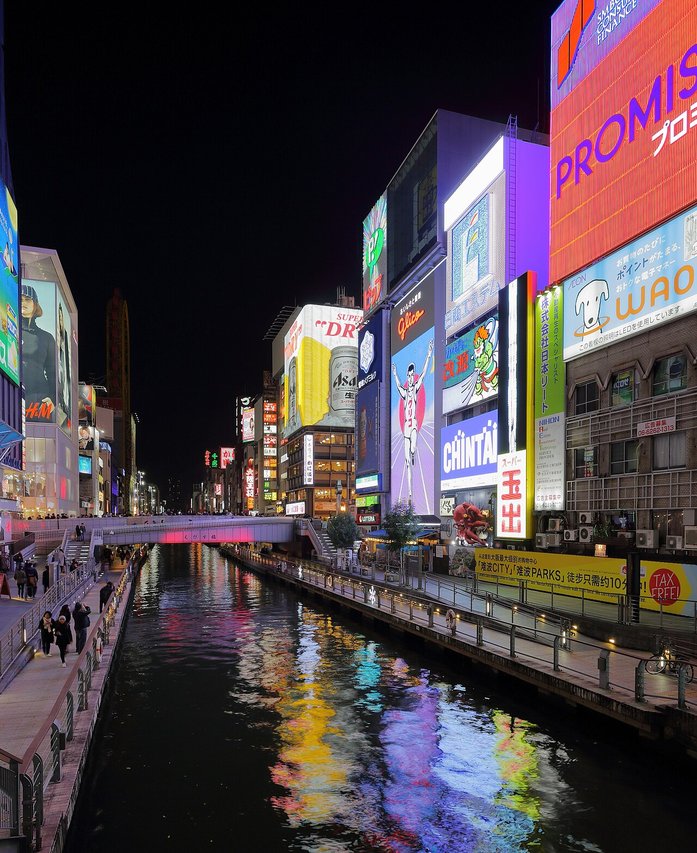
The Dotonbori canal at night, lit by neon signs in the heart of Osaka's Namba district — Namba Station is the rail hub of the Minami area
Namba/Dotonbori (Minami) is one of the city's two main poles — Namba Station links the Osaka Metro Midosuji line with the Nankai, Kintetsu and Hanshin private railways all in one place.
The lines you'll use most, easy to spot by colour

Lines visitors use most

Line Route Key stops
Midosuji (red · M) North ↔ south (the main artery) Shin-Osaka · Umeda · Shinsaibashi · Namba · Tennoji
JR Osaka Loop (orange · O) Circles the city centre Osaka (Umeda) · Tennoji · Nishi-Kujo (change for USJ)
Chuo (green · C) East ↔ west Hommachi · Osaka-Port (Kaiyukan Aquarium) · Cosmosquare
Sakaisuji (brown · K) North ↔ south (the eastern side) Nipponbashi (Kuromon Market) · Tenjinbashisuji 6-chome
The one tip that matters: if you can't keep all the lines straight, just remember one — the red Midosuji — because it touches Umeda, Shinsaibashi and Namba, the districts where most visitors stay and spend their time. If your hotel sits on this line, life gets a lot easier. See more on where to stay around Namba in the Namba area guide.
Cards & paying

How to pay your fare — ICOCA, Suica and single tickets

💳
ICOCA

JR West's IC card, ¥2,000 (¥1,500 of travel value + a ¥500 deposit you can refund). Tap it on the Metro, JR, the private railways and buses, and to pay in convenience stores.

📲
Suica / Pasmo

Already have a Tokyo IC card? Use it as-is. Suica, Pasmo and ICOCA all tap through nationwide — straight through the gates of every rail company in Osaka, no new card needed.

🎫
Single ticket

Buy from a machine in the station. English menu — tap your destination and it shows the fare. Takes coins and notes.

🗓️
Unlimited-ride passes

The Enjoy Eco Card or the Osaka Amazing Pass give unlimited rides — worth it on a day with lots of trips. See the table below for which one fits which day.

Physical-card status for 2026: back in 2023 an IC-chip shortage paused sales of plain Suica/Pasmo cards for a while, but they've been on sale normally again since March 2025. Kansai's ICOCA was less affected and is reliably stocked at JR machines and counters. If you're worried about not finding a card, alternatives include the Welcome Suica (no deposit, but it expires after 28 days) or Mobile Suica / Mobile ICOCA on your phone (2026 prices may change — check the latest before you travel).
Value passes

Unlimited-ride passes — which fits which day

Pass Price (adult) Covers / conditions
Osaka Amazing Pass (1 day) ¥3,500 Unlimited Metro + buses + some private lines + free entry to ~40 sights · worth it if you enter several attractions
Osaka Amazing Pass (2 day) ¥5,000 Same as the 1-day but over two consecutive days · works out cheaper at ¥2,500/day
Enjoy Eco Card (weekday) ¥820 Unlimited Osaka Metro + city buses for one day · no attraction entry · pays off from about 4–5 rides
Enjoy Eco Card (weekend/holiday) ¥620 Same as the weekday version but cheaper · grab this one whenever it's a weekend or holiday

To put it plainly, the easiest way to choose is to ask whether that day is about "going into sights" or "just riding the trains". If you're set on Osaka Castle, the Umeda Sky Building, the Tombori River Cruise and Tsutenkaku, the ¥3,500 Osaka Amazing Pass pays off immediately, because the entry fees alone add up to more than the pass. But if the day is just eating and shopping with a few train rides, use the Enjoy Eco Card (¥620 on weekends / ¥820 on weekdays) or simply tap ICOCA per ride. On a day heading out to Kobe, Nara or Himeji, look separately at a Kansai Area Pass in our JR Kansai Pass guide.

Other ways to get around

Private railways, the JR Loop, buses and taxis

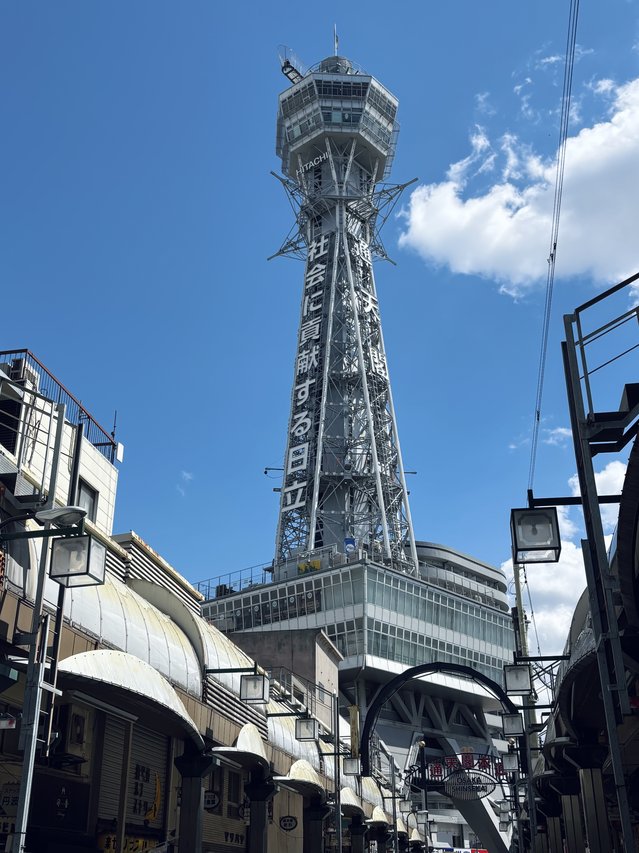
The Tsutenkaku tower above the Shinsekai district of Osaka — reached on the Osaka Metro Midosuji/Sakaisuji lines, getting off at Ebisucho or Dobutsuen-mae Private railways · out into Kansai
Private Railways
Hankyu · Hanshin · Keihan · Kintetsu · Nankai

Osaka is the base for exploring Kansai, and the lifelines that carry you out of the city are five main private railway companies. Each has different destinations — the easy way to remember it is to match where you're going to which line.

Hankyu/Hanshin → Kobe and Kyoto · Keihan → Kyoto (handy for Gion-Shijo/Fushimi Inari) · Kintetsu → Nara and Ise · Nankai → Kansai Airport (KIX) and Koyasan. Every line takes ICOCA/Suica, or buy a single ticket at the machine.

To Kobe/Kyoto: Hankyu or Hanshin (from Umeda)
To Kyoto: Keihan (from Yodoyabashi/Kyobashi)
To Nara: Kintetsu (from Namba/Tsuruhashi)
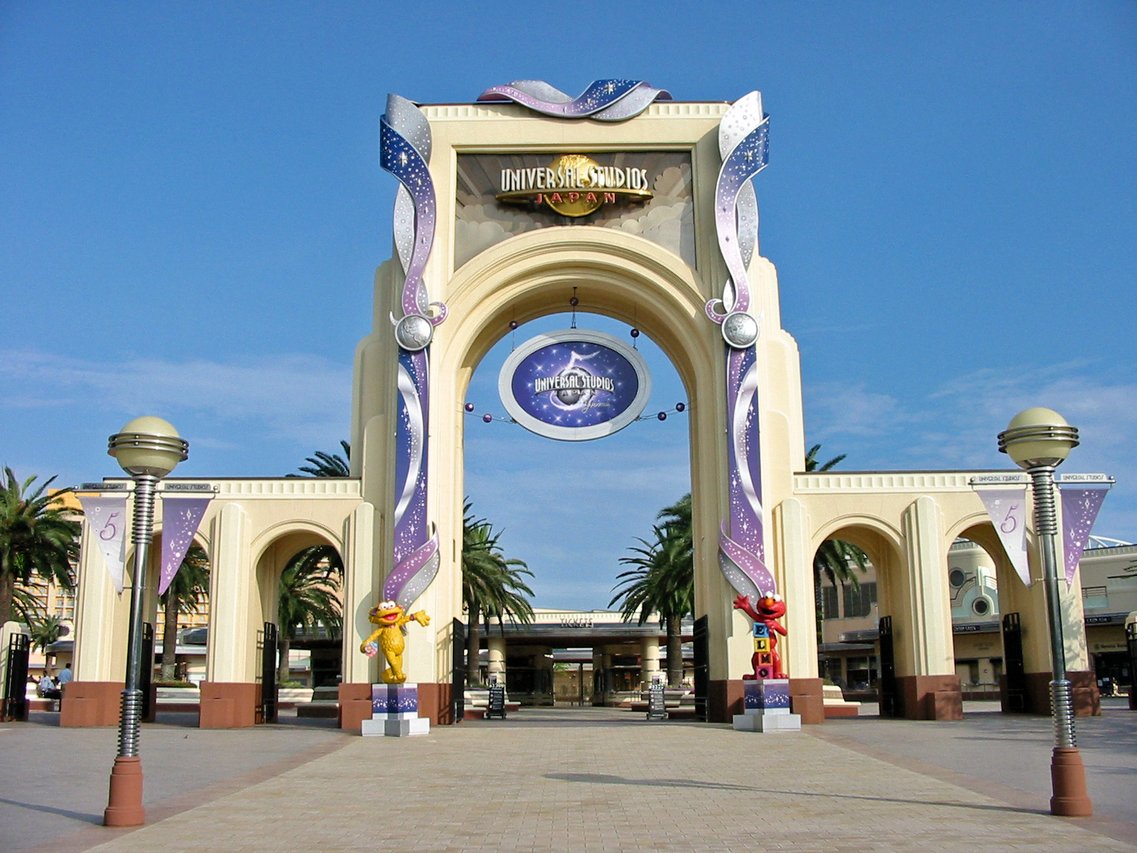
The entrance arch of Universal Studios Japan in Osaka — take the JR Osaka Loop Line to Nishi-Kujo, then change to the JR Yumesaki Line for Universal City JR Loop · USJ
JR Osaka Loop + getting to USJ
大阪環状線 · ゆめ咲線 Yumesaki Line

The JR Osaka Loop Line circles the city like Tokyo's Yamanote, letting you reach districts on the ring quickly without switching systems — but the role visitors use it for most is getting to Universal Studios Japan.

How to reach USJ: take the JR Loop Line to Nishi-Kujo, then change to the JR Yumesaki Line (Sakurajima Line) and get off at Universal City — around 15–20 minutes total from Osaka Station, and you can tap ICOCA/Suica the whole way.

To USJ: Osaka → Nishi-Kujo → change to Yumesaki → Universal City
Time: ~15–20 min from Osaka Station
Pay with: ICOCA/Suica or buy a ticket at the machine
🚌
City Buses
大阪シティバス · fills the gaps the trains miss

The Osaka City Bus reaches places the subway doesn't yet cover, such as certain museums or riverside areas. The adult fare is a flat ¥210 per ride, paid by ICOCA, Suica or cash (you pay as you board at the front).

For visitors the trains are still easier, since most bus signs and on-board announcements are in Japanese. But if you plan your route in Google Maps, it gives you the route number and the stop to get off at, which makes the buses far less daunting — and the Enjoy Eco Card works on buses too.

Fare: adult flat ¥210 per ride
Pay with: ICOCA · Suica · cash (keep coins handy)
Recommended: use Google Maps to plan bus routes
🚕
Taxis
タクシー · always on the meter

Osaka taxis are all metered, with a flag-fall of around ¥600. They're ideal late at night after the trains stop (most trains finish around midnight), when you have a lot of luggage, or when you're a group of 3–4 splitting the fare. Most cars take credit cards and IC cards.

Tip: most drivers speak little English, so have your destination written in Japanese or show the driver a dropped pin in Google Maps — that's the simplest way. The GO and DiDi apps hail cars in Osaka too, though in the city centre flagging one on the street or joining a station rank works just as well.

Flag-fall: from around ¥600
Best for: late night after trains stop · luggage · travelling in a group
Pay with: cash · credit card · IC card (most cars)
Travel tips

Dodge the rush hour and the apps that genuinely help

Osaka is one of Japan's biggest cities, and rush-hour trains really do get packed — especially the Midosuji line in the morning ~7:30–9:00 and evening ~17:30–19:30. If you've got big luggage or you're travelling with kids, try to avoid these windows; setting out a little later and heading back a little later in the evening is far more comfortable.

On big luggage: the main stations — Umeda, Namba and Tennoji have plenty of coin lockers. If you've checked out but want to keep sightseeing before your train, leaving your bags in a locker beats dragging them around all day. And when boarding a train, always look for a lift or escalator rather than the plain stairs.

🗺️
Google Maps works fully
Unlike China · no VPN needed

Japan doesn't block Google, so Google Maps is highly accurate in Osaka, showing the Osaka Metro, JR, the private railways and buses with times, fares and which company's train to take. Type station names in English or any language. Keep a SIM or eSIM with data on you as you go.

Recommended: keep mobile data on you (SIM/eSIM) while travelling
Note: the Japan Transit Planner and Navitime apps are detailed too
🧳
Big luggage + rush hour
Lockers · lifts · avoid the rush

Avoid trains in the morning 7:30–9:00 / evening 17:30–19:30. With big luggage, use the lockers at Umeda/Namba/Tennoji (or a delivery service that sends bags to your hotel) and sightsee hands-free — much smoother. Most trains stop running around midnight, so factor in the last service when planning a late night out.

Avoid the rush: morning 7:30–9:00 · evening 17:30–19:30
Luggage: lockers at the main stations · look for a lift
First time in Osaka? Pick a hotel on the Midosuji line around Umeda (Kita) or Namba/Shinsaibashi (Minami) and life gets a lot easier — this single line touches both poles of the city, and connects on to trains for Kyoto/Nara/Kobe. See more on where to stay and what to do in the Osaka travel guide and the Namba area guide.
The real tip

Match the pass to your style and save across the whole trip

If we had to give one piece of advice: check first whether each day is about "going into sights" or "just riding the trains", because it changes which pass is cheapest in an instant — on a day of touring paid attractions, grab the Osaka Amazing Pass at ¥3,500 (free entry to ~40 sights); on a day of riding without limits, use the Enjoy Eco Card (¥620 weekends / ¥820 weekdays); and on a day with only a few rides, just tap ICOCA or Suica per ride.

One more thing that helps: keep the role of each system clear — the Osaka Metro Midosuji line is your backbone in town, the JR Loop is for USJ days or districts on the ring, and the private railways (Hankyu/Hanshin/Keihan/Kintetsu/Nankai) are for days heading out into Kansai or to and from the airport. Knowing this, you won't buy a pass you don't need.

A base for exploring Kansai: Osaka sits right in the middle — about 30–45 minutes by train to Kyoto, 30–45 minutes to Nara (Kintetsu) and around 30 minutes to Kobe (Hankyu/Hanshin), all easy as day trips. If you're planning to visit several cities, see which ticket pays off in the JR Kansai Pass guide, and how to get in from the airport in the Kansai Airport (KIX) guide.
Common questions

FAQ · Getting around Osaka

How much does the Osaka Metro cost?
The Osaka Metro charges distance-based fares, starting at ¥190 for Zone 1 (up to about 3 km) and rising to around ¥390 for the longest journeys. The central routes that visitors use most, such as Umeda–Shinsaibashi–Namba on the Midosuji Line, mostly fall in the ¥190–240 range. Pay by tapping an ICOCA, Suica or other IC card, or buy a single-journey ticket from a machine with an English menu (2026 prices may change — check the latest on the ticket-machine screen).
What is the ICOCA card, and can I use a Suica in Osaka?
ICOCA is JR West's rechargeable IC card, costing ¥2,000 (¥1,500 of travel value plus a ¥500 deposit you can refund before you leave). You can tap it on the Osaka Metro, JR, the private railways and buses right across Kansai, and use it to pay in convenience stores too. Suica and Pasmo from Tokyo are interchangeable nationwide, so if you already have a Suica, just tap it in Osaka — there's no need to buy a new ICOCA.
Is the Osaka Amazing Pass worth it, and when should I buy one?
The Osaka Amazing Pass costs ¥3,500 (1 day) or ¥5,000 (2 days) and gives unlimited rides on the Osaka Metro, city buses and some private railway lines, plus free entry to around 40 attractions — Osaka Castle, the Umeda Sky Building, the Tombori River Cruise and Tsutenkaku among them. It's great value if you plan to enter several paid sights that day — just 3 to 4 and you've already beaten the price. But if the day is more about eating and shopping than going into attractions, the Enjoy Eco Card or simply tapping ICOCA per ride works out cheaper (2026 prices may change).
How do I get from Kansai Airport (KIX) into Osaka?
There are several options depending on where you're staying. If you're near Namba, the Nankai private railway — the Rapi:t or the Airport Express — runs straight into Namba. If you're near Umeda or Tennoji, the JR Haruka or the JR Kansai-Airport Rapid Service is more convenient. The trip takes around 35–50 minutes depending on the service and your destination. A cheaper option is the limousine bus to major city hotels. Read the full breakdown in our Kansai Airport guide.
Which travel pass is best value for tourists in Osaka?
It depends on the style of your day. If you plan to enter several paid attractions in one day, use the Osaka Amazing Pass at ¥3,500 (free entry to ~40 sights). If you just want unlimited subway and bus rides without focusing on attractions, use the Enjoy Eco Card (Osaka 1-Day Pass) at ¥820 on weekdays or ¥620 on weekends and holidays. On days when you only make a few trips, just tapping ICOCA or Suica per ride is enough — no pass needed. And if you're heading out to Kobe, Nara or Himeji on a day trip, look separately at a Kansai Area Pass.
Can I use Google Maps to get around Osaka?
Yes, and it works very well. Japan doesn't block Google, so Google Maps shows complete, accurate data for the Osaka Metro, JR, the private railways and buses — routes, times, fares and which company's train to take. You can enter station names in English. The Japan Transit Planner and Navitime apps are detailed too. Keep a SIM or eSIM with data on you while you travel.