Land at a single airport — Kansai (KIX) — and use it as a base for Osaka, Kyoto and Kobe alike. There's a choice for every traveller, from the full-service comfort of Thai Airways and JAL to budget carriers like Peach and Thai AirAsia X. This guide helps you pick the one that fits your budget and your style of travel.
The real appeal of flying to Osaka is that you land at one airport and can travel the whole region from it — Kansai Airport (KIX) is the gateway to Osaka, Kyoto, Kobe and Nara. If you're planning a multi-city Kansai trip in one go, this route makes a lot of sense. The Bangkok–Osaka corridor has several airlines to choose from: full-service carriers like Thai Airways and Japan Airlines, which bundle baggage and meals into the fare, and budget carriers like Peach, Thai Vietjet and Thai AirAsia X, which start lower but charge for every extra separately.
The key things to know before you book: a direct flight from Bangkok to Kansai takes about 5.5–6 hours, and Japan is 2 hours ahead of Thailand. Return economy tickets run roughly ฿11,000–28,000, depending on the season and how far ahead you book. The expensive periods — when seats fill fast — are cherry blossom (late March–April), autumn leaves (November), Golden Week (late April–early May) and New Year. Dodge those and you'll save a lot.
Schedules change with the season — always verify current timetables before booking.
| Airline | Type | Departs from | What's included | Notes |
|---|---|---|---|---|
| Thai Airways (TG) | Full Service | Suvarnabhumi (BKK) | Checked bag + meal + seat selection | Thailand's flag carrier, flying direct to Kansai. Long-established experience on the Japan corridor. |
| Japan Airlines (JL) | Full Service | Suvarnabhumi (BKK) | Checked bag + meal + seat selection | Japan's carrier flying BKK–KIX direct, often on a Boeing 787, with the in-flight service standards you'd expect from a Japanese airline. |
| ANA (NH) | Full Service | Suvarnabhumi (BKK) | Checked bag + meal + seat selection | Japanese carrier that codeshares with TG on some services — check current schedules before booking. |
| Peach Aviation (MM) | Low Cost | Suvarnabhumi (BKK) | Base fare only — all extras charged separately | Japan's budget carrier, with Kansai as its hub. Low base fare — ideal if you travel light. |
| Thai Vietjet (VZ) | Low Cost | Suvarnabhumi (BKK) | Base fare only — all extras charged separately | Budget carrier out of Suvarnabhumi, often with low base-fare promos. Add baggage and seat selection on top. |
| Thai AirAsia X (XJ) | Low Cost | Don Mueang (DMK) | Base fare only — all extras charged separately | Budget carrier out of Don Mueang, flying an Airbus A330 — has been trimming frequencies since April 2026, so check the schedule first. |
Every flight from Thailand lands at Kansai Airport, while Itami (ITM) handles mostly domestic routes.
The main international airport for the Kansai region, built on a man-made island in Osaka Bay, with a terminal designed by Renzo Piano. Every international flight from Thailand lands here, and it serves Osaka, Kyoto, Kobe and Nara alike.
North of the city and closer to the centre than KIX, Itami handles mainly domestic flights within Japan. If you take an onward domestic flight — to Hokkaido or Okinawa, say — you might use this airport, but flights from Thailand don't land here.
A direct Bangkok–Kansai flight takes about 5.5–6 hours, depending on the wind direction and the route flown that day. The thing many people forget is that Japan is 2 hours ahead of Thailand — leave Bangkok at midnight, fly nearly 6 hours, and you'll land at Kansai in the morning Japan time. Build that time difference into your plan for the first day's itinerary too.
Full-service carriers like Thai Airways and Japan Airlines usually include an in-flight meal, a personal entertainment screen and checked baggage in the fare. On Peach, Thai Vietjet and Thai AirAsia X the aircraft takes the same time, but this distance counts as fairly long for a low-cost flight — if you're travelling as a family or with lots of luggage, work out the all-in price before you decide.
Leaving KIX, there are several ways into the city: the Nankai train to Namba station in central Osaka, ~¥970, about 45–50 minutes (the Rapi:t express ~¥1,490, about 38 minutes) · JR trains to Tennoji/Osaka stations · if you're heading straight to Kyoto, there's the JR Haruka limited express · plus limousine buses and taxis for travellers with lots of bags or in a group.
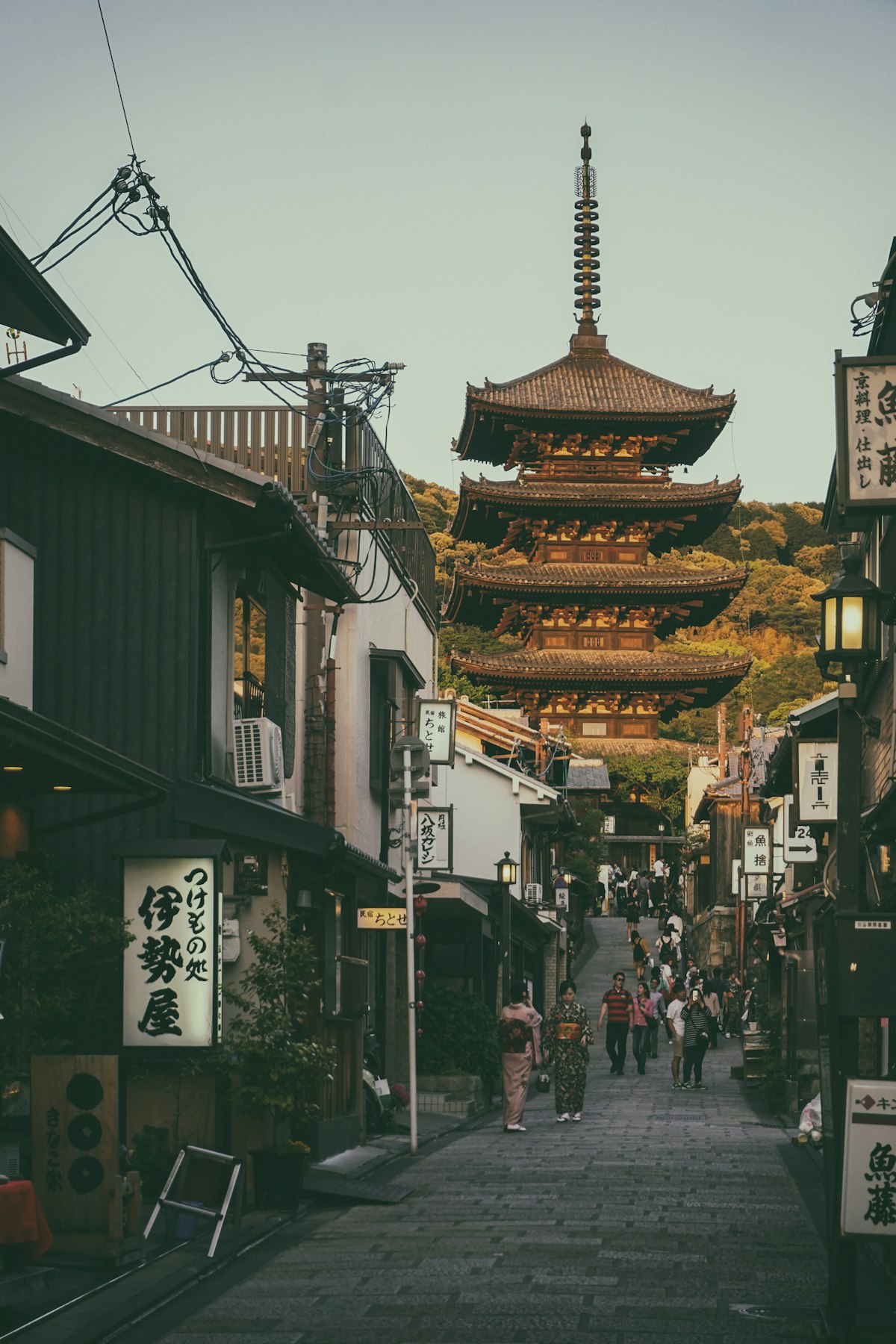
The best thing about flying into Kansai is using it as a base for several cities in a single trip — from the airport, a train reaches Osaka in ~45 minutes, or the JR Haruka takes you to Kyoto in about 70 minutes. Kobe and Nara are both within day-trip distance by train. If you like to city-hop, it's worth checking whether a JR Pass suits your plan.
Cherry blossom season (late March–early April in Kansai) is true high season — flights and hotels spike and seats fill fast. It's followed by Golden Week in late April–early May, which is just as pricey.
Early summer brings the rainy season (tsuyu), then it turns hot and humid. Fares run mid-to-high as it overlaps with Thai school holidays and Japan's summer festivals — great if you want to catch a matsuri and fireworks.
Cool, comfortable and easy for sightseeing, with good fares early in the season — but during the autumn leaves (November), especially in Kyoto, flights and hotels climb steeply. Book well ahead.
The lowest fares of the year outside the New Year period. It's cold, but central Kansai rarely sees much snow — good for shoppers and winter crab. Avoid the year-end to New Year window, when prices surge.
Osaka sits at the heart of the Kansai region, so once you fly in you can easily reach the surrounding cities by train in a single trip: Kyoto in about 15 minutes by shinkansen, or ~30 minutes on a regular express · Kobe in ~30 minutes · Nara in ~45 minutes. If you're visiting several cities, or heading as far as Hiroshima, a JR Pass or a Kansai travel pass often saves money — work it out against your plan first.