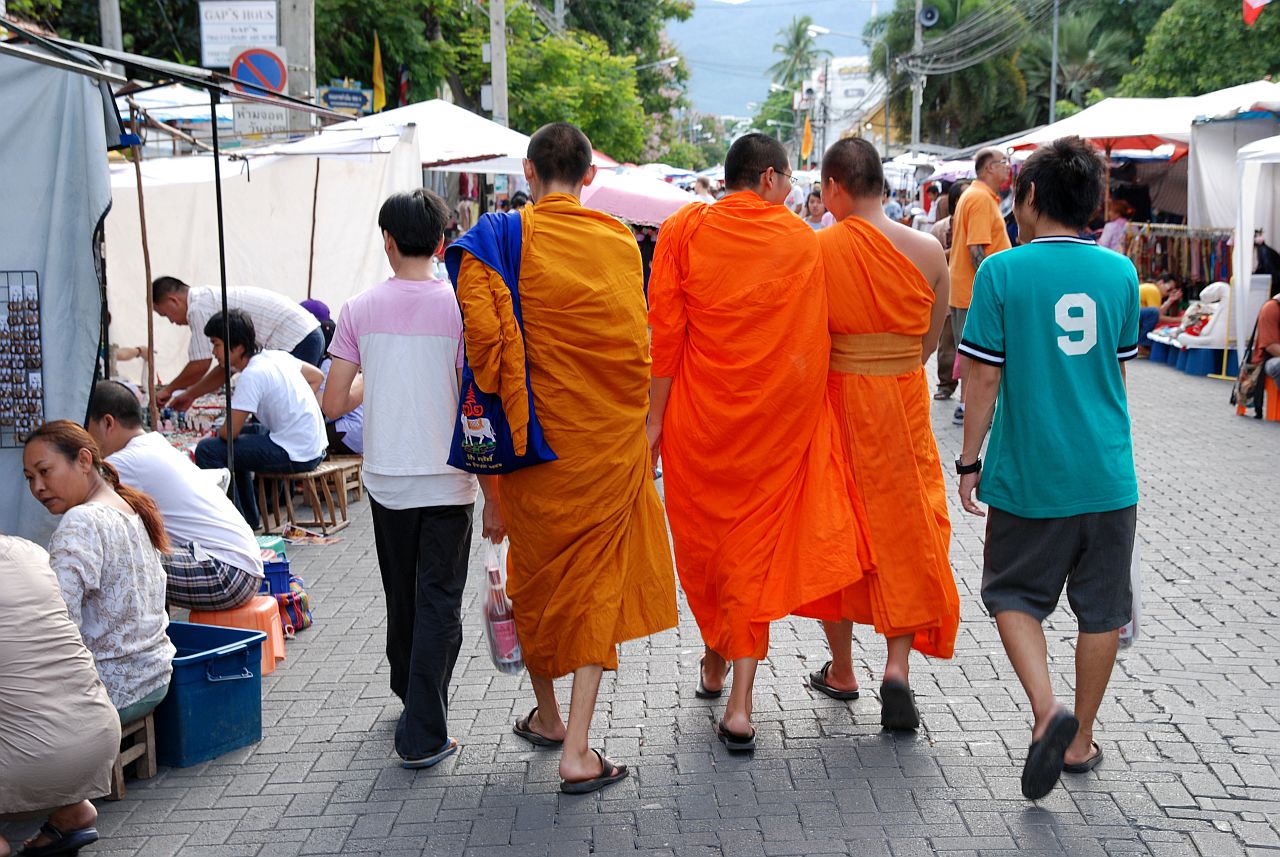
Every Sunday evening, Ratchadamnoen Road through the Old City closes to traffic and becomes a kilometre-long market from Tha Pae Gate to Wat Phra Singh — handmade goods, woven textiles, northern street food and live buskers the whole way. Free to wander.
Picture it: six in the evening on a Sunday, and you are standing at Tha Pae Gate with the old brick wall behind you catching the last warm light of the afternoon. Ahead, Ratchadamnoen Road is closed to cars and full of people moving like a slow river. Stalls of woven cloth and mulberry-paper lanterns line both sides, the smell of grilling northern sausage drifts past, and in a temple courtyard off to the side a group of students is playing music for tips. This is a Chiang Mai Sunday.
The Sunday Walking Street takes over Ratchadamnoen Road, the Old City's main axis, running straight from Tha Pae Gate in the east to Wat Phra Singh in the west — about a kilometre. The whole stretch is pedestrianised, and several hundred traders set up to sell Lanna handicrafts, handmade goods and local food. Temple courtyards that open onto the road, such as Wat Phan Tao and Wat Chedi Luang, turn into food zones with somewhere to sit.
What sets it apart from other Chiang Mai markets is straightforward: free to enter, and most of what is on sale is genuinely made by the people selling it, not factory knock-offs. Locals and visitors come for the same reasons — the atmosphere, the things worth buying, and the food.
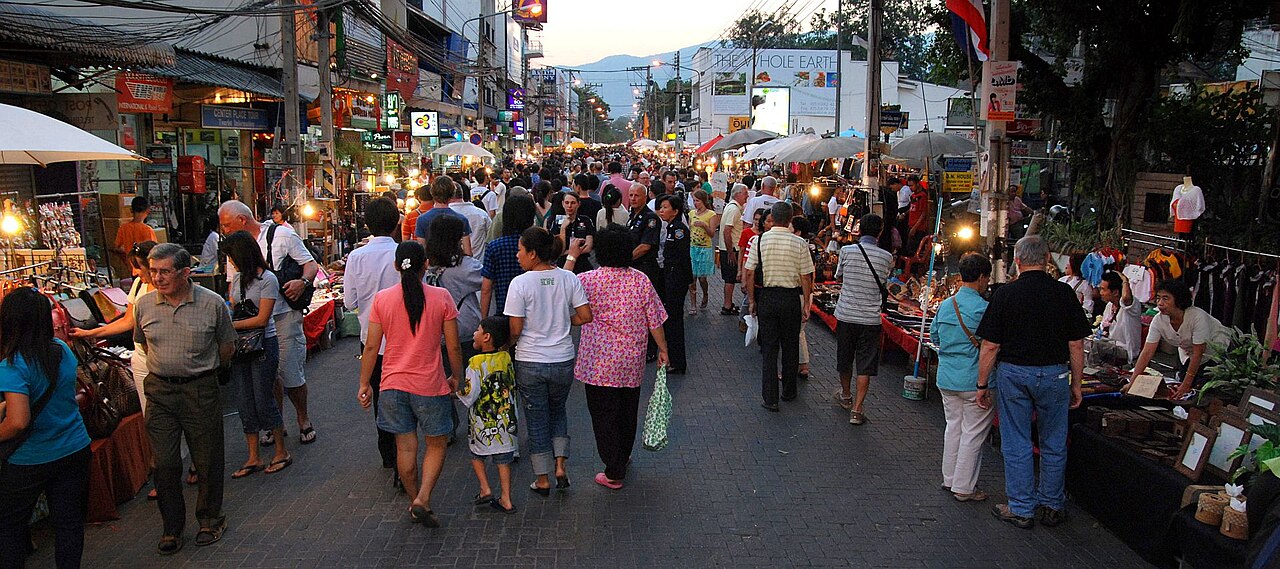
Walk from Tha Pae Gate toward Wat Phra Singh — each stretch has its own goods and atmosphere.
The wide plaza at Tha Pae Gate is the easiest place to start and the city's best-known landmark. In the early evening there is often live music or street performance for tips, flocks of pigeons, and people photographing the old brick wall. From here, turn onto Ratchadamnoen Road and walk straight into the market.
The first stretch past Tha Pae Gate is packed with craft stalls — cloth bags, printed T-shirts with city motifs, postcards and watercolours by local artists, silver jewellery, and mulberry-paper lanterns. Plenty of sellers make their own work, so it pays to walk slowly and pick out gifts you will not find in a mall.
Along the way you will pass temple courtyards that branch off the main road and become open-air food courts with tables. This is where to stop and eat — khao soi, khanom jeen nam ngiao, sai ua (northern sausage), crispy pork, grilled meatballs and local sweets. Refuel and carry on.
Musicians and performers set up at intervals all along the road, from schoolkids playing traditional strings to acoustic acts. At some spots an artist will sketch a portrait or write your name in beautiful lettering. Drop in whatever you like — it is the kind of thing that makes the evening feel different from an ordinary market.
Ratchadamnoen Road ends at Wat Phra Singh, the revered old temple that looks beautiful floodlit at night. This stretch usually has inexpensive roadside foot massage — a good place to rest after the full walk. If you still have energy, you can step inside to pay respects (dress modestly, shoulders and knees covered).
The heart of the Sunday Walking Street is northern Thai handmade craft. The things worth buying — and most distinctive — are cotton and woven textiles, mulberry-paper lanterns and homeware, silver jewellery, cloth bags and hill-tribe-style clothing, plus soaps, scented goods and local artists' paintings. At many stalls the maker is sitting right there working, and prices are well below mall rates.
Prices here are fairly friendly and usually marked, so there is no need to bargain hard the way you might at some markets. If you buy several pieces from one stall, it is fine to ask politely for a small discount with a smile — most traders are easygoing.
The best food zones are usually not on the main road but in the temple courtyards that open off it, such as Wat Phan Tao and Wat Chedi Luang. Stalls cluster there into open-air food courts with tables. Things to try include chicken khao soi, khanom jeen nam ngiao, sai ua (northern sausage), crispy pork, grilled meatballs, roti and local sweets. Most dishes run ฿20–60, so you can graze your way along.
If you want a proper sit-down meal, arrive before 6.30 pm — finding a table is much easier then. After that the courtyards fill up fast.
Beyond the shopping and eating, the real draw is the atmosphere. Buskers and performers set up at intervals the whole way, and at some corners an artist sketches portraits or writes names in elegant lettering. The best photo spots are the Tha Pae Gate plaza at dusk, while the old brick wall still has warm light, and Wat Phra Singh after dark when the chedi is floodlit.
For good light and thinner crowds, come between 4 and 5.30 pm, when stalls are just setting up and the sky still has colour. After that it becomes a sea of people — fun in its own way, but harder to photograph.
If you are staying in the Old City you can simply walk, since the market sits right in the middle of it. From outside the moat, the options are easy.
Stay inside the moat or around Tha Pae and you can step out of your hotel straight into the market.