Home Chiang Mai Thailand Chiang Mai Hotels About
Home  ›  Asia  ›  Thailand  ›  Chiang Mai  ›  Northern Thai Food
🇹🇭 Lanna Home Cooking · 2026

Beyond khao soi
eat what locals actually eat

Chiang Mai isn't only khao soi. Inside a northern restaurant, the local tables are loaded with the everyday plates the tour guides skip — grilled sai ua, smoky nam prik num with pork crackling, meltingly tender gaeng hung lay, fragrant larb khua. This is the taste that tells you you've really arrived.

The tradition

Aahaan mueang — the food the north calls home

Here's the thing: most visitors land in Chiang Mai and eat just a handful of things — a bowl of khao soi, some khanom jeen, a few cafés, done. But step into a northern restaurant and you'll see the local tables loaded with the dishes the tours rarely mention — a small bowl of chilli dip, a plate of steamed vegetables, a basket of sticky rice, all rolled and dipped and shared around the table.

Northern Thai cooking grew from several sources — the old Lanna kitchen, layered with influences from Burma, the Shan, and Yunnan China that traded through Chiang Mai for centuries. Gaeng hung lay comes from Burma, khanom jeen nam ngiao has Shan roots, and even khao soi carries a Burmese-style curry character. The core flavours are savoury, herbal and chilli-forward, with far less sugar than central-Thai food, leaning on grilled meats, ferments, chilli dips and spice. It's eaten mostly with sticky rice and local vegetables.

The heart of a northern meal is the shared spread — not one plate to yourself, but a chilli dip or two, a pot of curry, something grilled like sai ua, pork crackling and steamed greens, all set out together. The most formal version is the khantoke, a tray-and-pedestal set that was once how Lanna hosts received their guests. This guide walks through 8 northern dishes worth ordering — khao soi and roadside snacks like khao kha moo get their own separate guides.

8 northern dishes

The home-style plates worth ordering

What's on the local tables inside a northern restaurant — eaten as a shared spread, dipped and passed around with hand-rolled sticky rice.
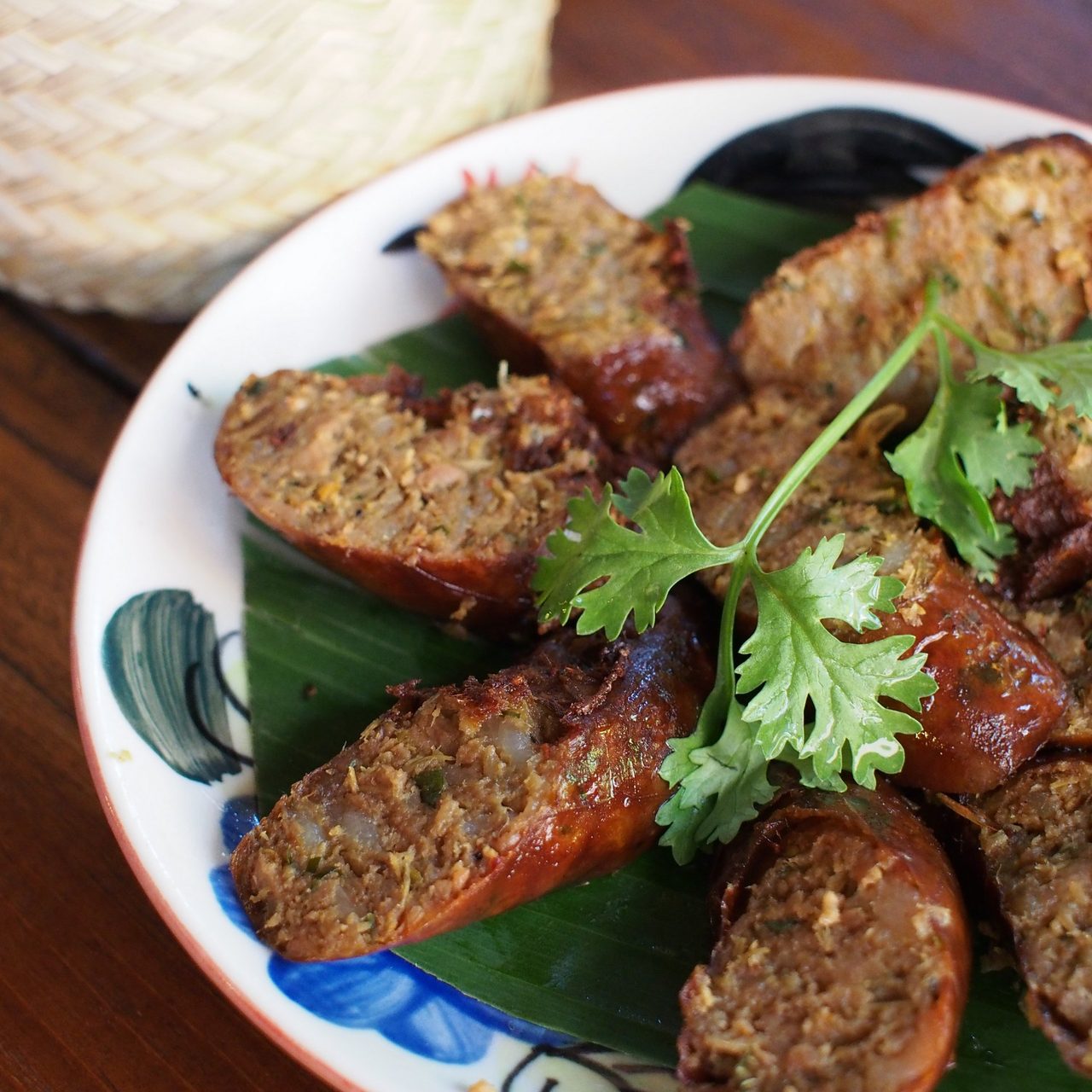
Sai ua — coils of grilled northern Thai herb sausage sliced on a banana leaf, with a basket of sticky rice 1
Sai ua
Grilled northern herb sausage — the opening plate of a northern spread

If you want to start understanding the northern kitchen, order this first. Minced pork is mixed with curry paste and fresh herbs — lemongrass, shredded kaffir lime leaf, chilli paste, turmeric — stuffed into a casing, coiled up and grilled slowly over low heat until the skin tightens and the fat glistens. The smell of lemongrass and lime leaf reaches you before the plate does. The inside is firm and springy, savoury and herbal without being overpowering. You slice it on the diagonal and eat it with hot sticky rice, or alongside nam prik num and pork crackling — that first bite of grilled herbs is the whole north in one mouthful. It's also the souvenir people carry home by the bagful.

Where: every northern restaurant · Huen Phen · Tong Tem Toh · Huen Muan Jai · Chiang Mai Gate market
Price: ฿60–120 / plate · sold by weight at markets, about ฿20–30 per 100g
Tip: best straight off the grill · the classic combo is with nam prik num and sticky rice
🍅2
Nam prik ong
Pork-and-tomato chilli dip — the north's mellow red dip

The chilli dip even non-spicy eaters can love — minced pork stir-fried with chilli paste and small tomatoes until the tomatoes collapse into a loose, orange-red sauce, mildly sweet and tangy, only gently hot, fragrant with fried garlic and shallot. It's thicker than nam prik num and comes with a platter of fresh and steamed vegetables — cucumber, long beans, cabbage, steamed pumpkin. You dip a piece of vegetable, then chase it with a knot of sticky rice. Locals often order nam prik ong alongside nam prik num so the table has both the mellow red one and the sharp green one. This is a dish even kids happily eat.
Where: Huen Phen · Huen Muan Jai · most northern restaurants
Price: ฿60–120 / set (with vegetables) · shares around the table
Note: mild heat, a good gateway to northern food · ask for extra steamed veg
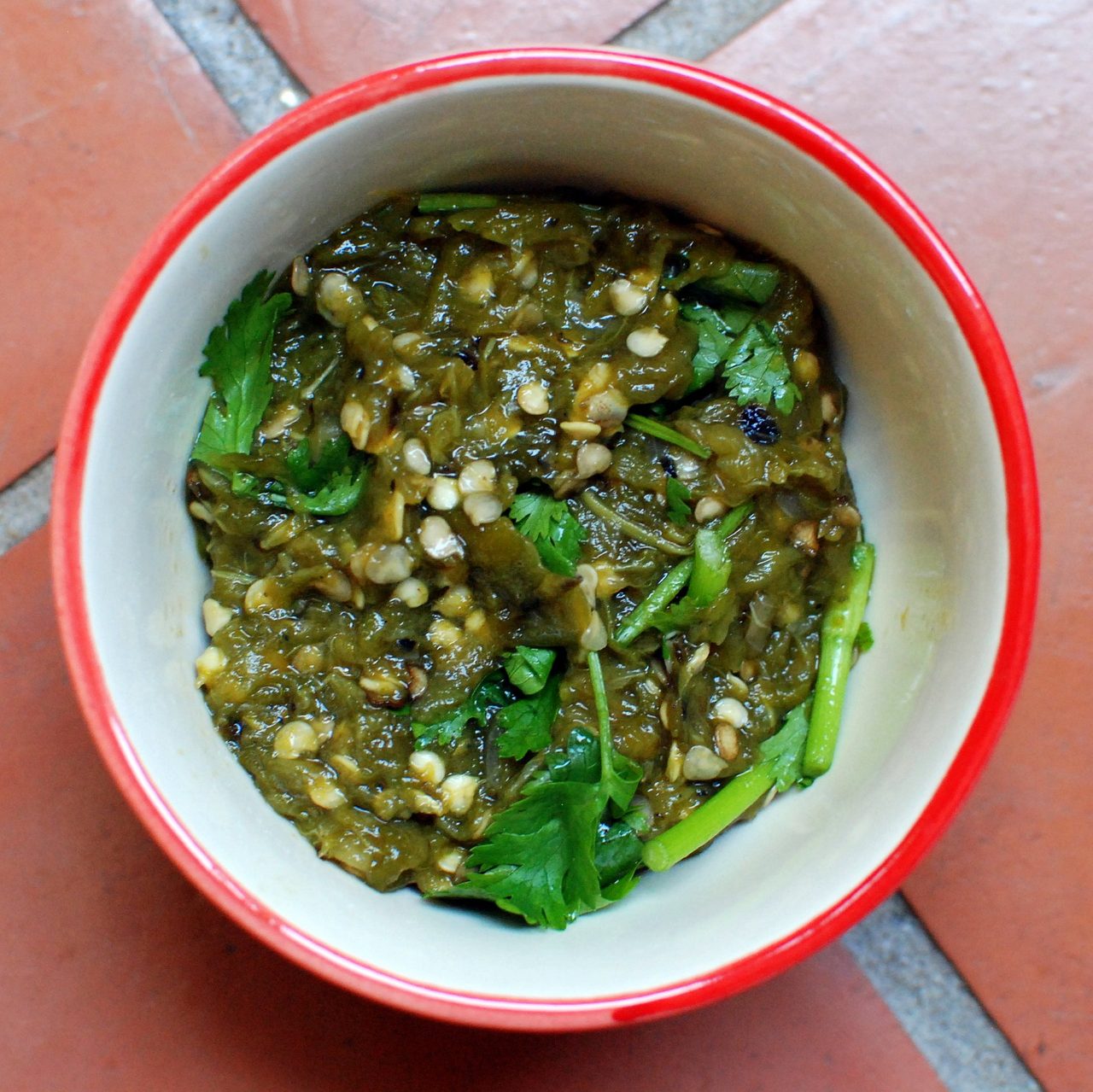
Nam prik num — a soft green roasted-chilli dip in a ceramic bowl, topped with coriander 3
Nam prik num
Roasted green-chilli dip, with pork crackling — the north's signature green dip

This is the dip on every northern table. Young green chillies (the long, mild kind) are roasted over fire with garlic and shallots until the skins char and turn fragrant, then pounded with salt into a soft, dusky-green paste with a medium heat and that unmistakable smoky-roasted aroma — no shrimp paste like a central-Thai dip. The classic partner is pork crackling (kaeb moo): you scoop the dip with a shard of crisp crackling instead of a spoon, then follow with steamed vegetables and sticky rice. It's the three-part combo Chiang Mai locals have eaten since childhood. Come all this way and skip nam prik num with pork crackling, and you haven't really arrived.
Where: every northern restaurant · Huen Phen · Tong Tem Toh · bagged at markets across town
Price: ฿50–100 / set (with crackling and vegetables)
Tip: use the pork crackling as your spoon · a touch hotter than nam prik ong
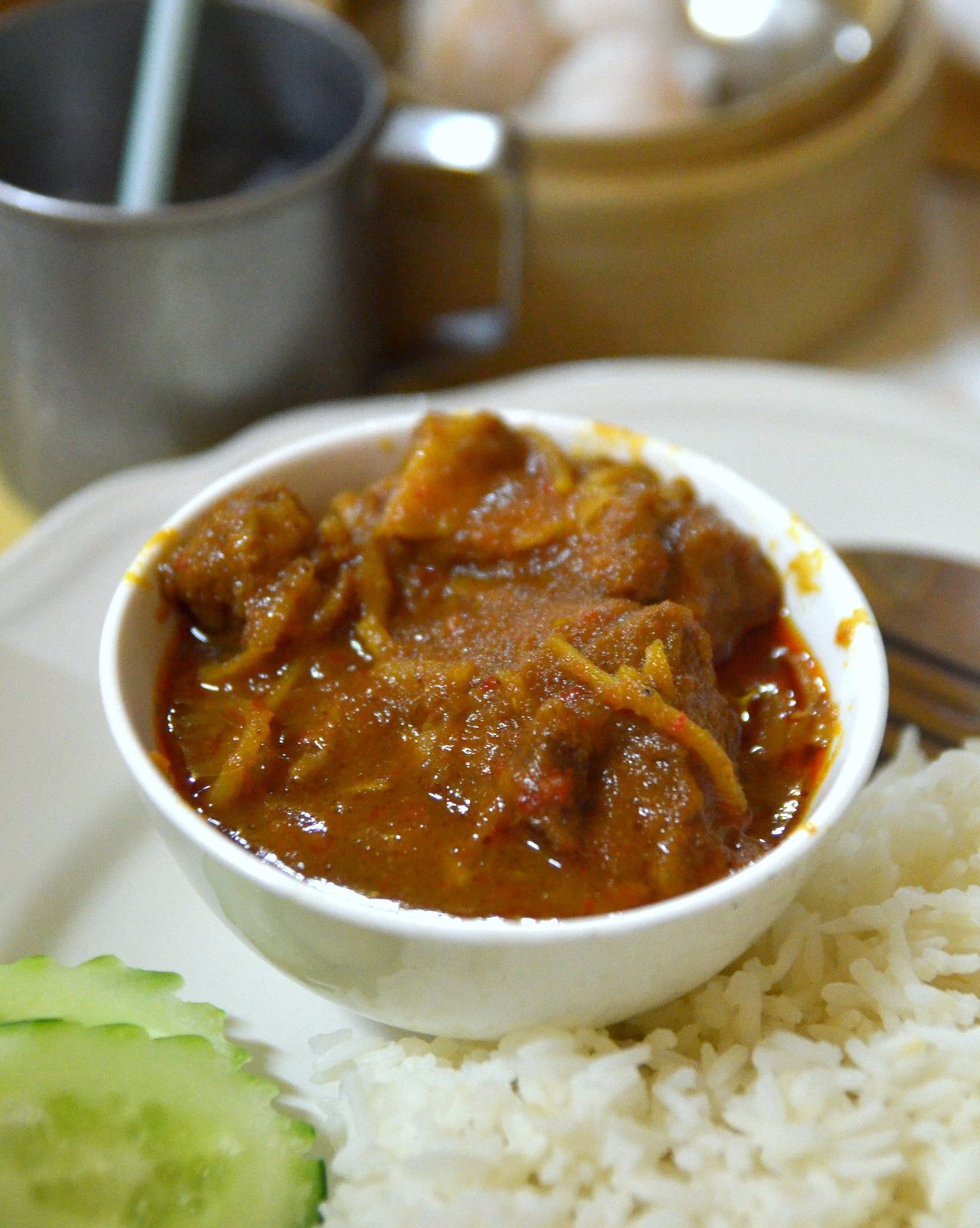
Gaeng hung lay — a thick reddish-brown pork belly curry with shredded ginger in a white bowl, served with rice and cucumber 4
Gaeng hung lay
Burmese-style pork belly curry — mellow, tangy, fragrant with ginger

The curry that always turns up at northern merit-making feasts. Big chunks of pork belly and fatty pork are simmered with hung lay curry paste, a mound of shredded ginger, pickled garlic, tamarind water and hung lay powder — a Burmese-style spice mix with coriander seed, cumin and turmeric — until the pork is so tender it nearly falls apart. The sauce is thick and deep, balanced between sour, sweet and savoury in a single spoonful, fragrant with ginger and spice rather than fiery like a southern curry. The name "hung lay" comes from Burmese, a nod to its cross-border trade roots. Eat it with hot sticky or steamed rice, spooning a tender piece of pork over the grains — it's one even cautious eaters tend to fall for.
Where: Huen Phen · Huen Muan Jai · Tong Tem Toh · most northern restaurants
Price: ฿80–150 / dish · shares between 2–3
Tip: get sticky rice to soak up the sauce · the longer it's braised, the softer the pork
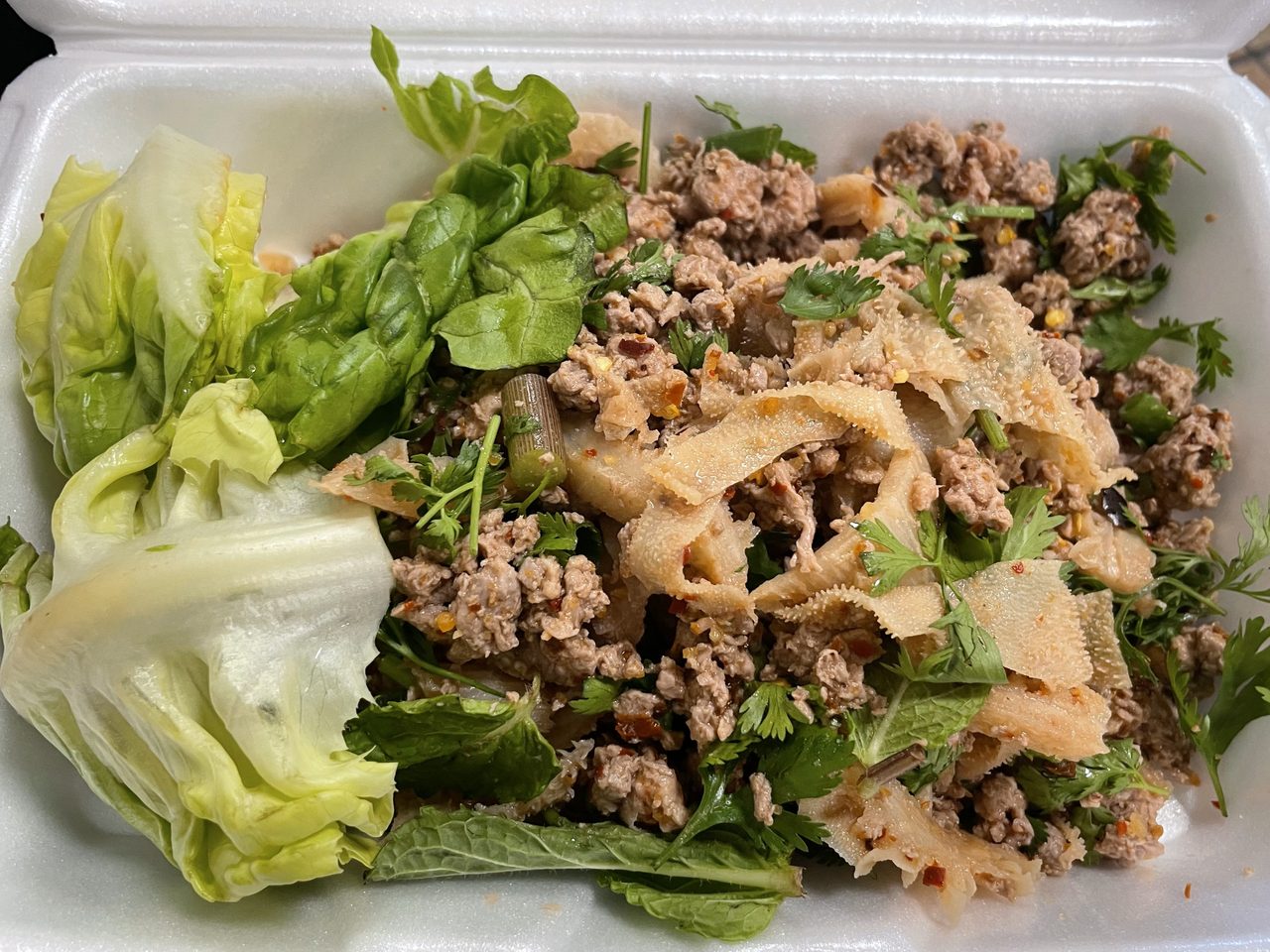
Larb khua mueang — northern-style minced-meat larb dry-fried with offal and herbs, served with fresh vegetables 5
Larb khua mueang
Northern larb, dry-fried with no lime — the dish that tests the spice blend

Northern larb is nothing like the Isan version — no lime juice, no toasted rice powder. Its whole soul is the larb spice blend, a dozen or more dry-roasted, ground spices (makhwaen prickly ash, dried chilli, long pepper, coriander seed, cumin) that give it that distinctly northern aroma. Finely minced pork or beef is mixed with the spice blend and blood, sometimes with offal worked in, then either dry-fried in a pan until cooked and fragrant (larb khua) or eaten raw (larb dip — for those who trust the kitchen). It's scattered with sawtooth coriander, spring onion and mint and eaten with raw vegetables like mint, pak phai and sticky rice. The flavour is deep, spiced and complex — if a kitchen's larb smells right, you know the cooks know what they're doing.
Where: Huen Phen · Huen Muan Jai · specialist northern larb shops · mueang restaurants
Price: ฿70–140 / dish
Tip: order it khua (fried) if you're unsure about raw meat · it's seriously spiced
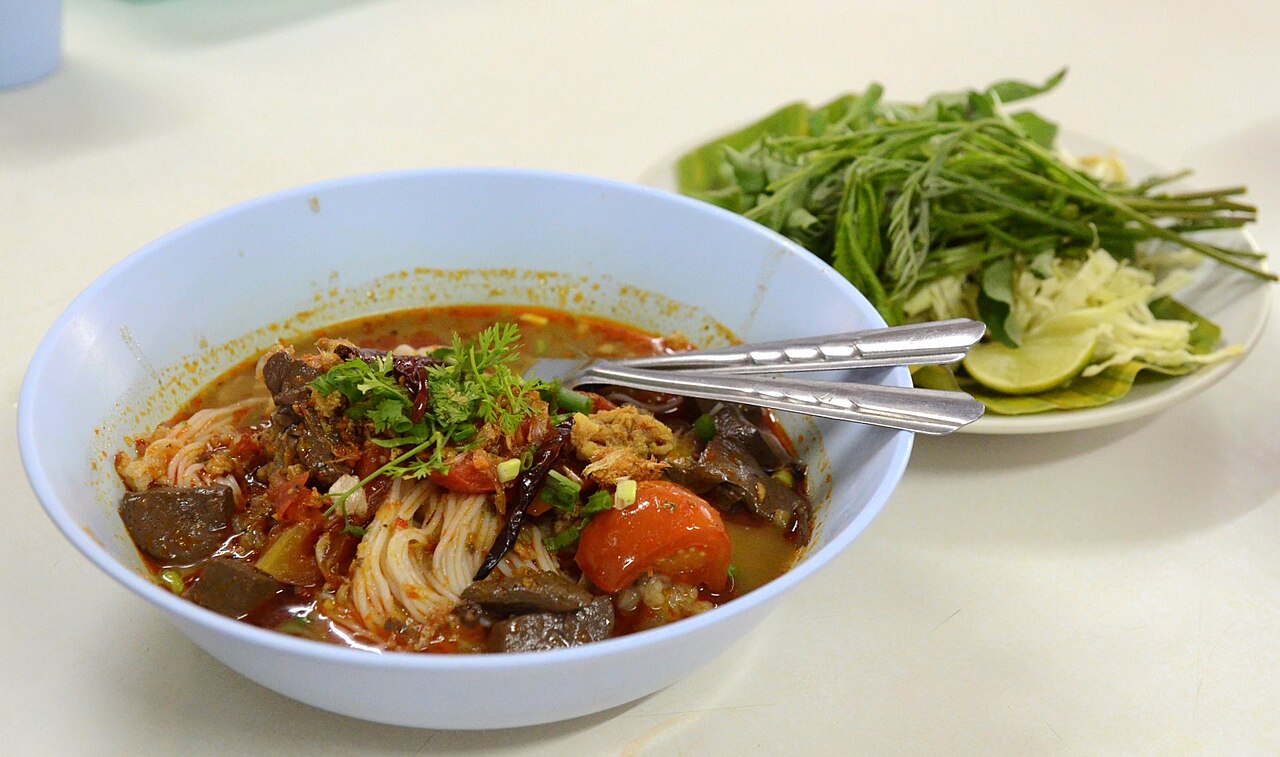
Khanom jeen nam ngiao — rice vermicelli in an orange-red tomato-and-pork-blood broth, with a side plate of herbs 6
Khanom jeen nam ngiao
Rice noodles in tomato-and-kapok broth — the noodle with Shan roots

If khao soi is Chiang Mai's coconut-curry noodle, nam ngiao is the clear-broth noodle locals eat more often. Fresh rice vermicelli (khanom jeen) is ladled over nam ngiao — a pork or rib broth simmered with small tomatoes, chilli paste, cubes of pork blood, and dried kapok flowers (dok ngiao), which give a distinctive chewy bite — until it turns an orange-red colour with a tangy, gently spicy balance. It's topped with bean sprouts, coriander and chilli flakes and eaten with pork crackling and pickled greens on the side. The name "ngiao" refers to the Shan, a nod to where the dish comes from. It's a one-bowl meal locals happily have for breakfast or lunch — lighter than khao soi, but no less punchy.

Where: specialist nam ngiao shops · morning markets · Huen Phen · mueang restaurants
Price: ฿40–70 / bowl
Tip: add a squeeze of lime and pickled greens to taste · eat it with pork crackling
🌶️7
Jin som / northern naem
Soured fermented pork, raw or fried — the north's everyday ferment

The northern kitchen is brilliant at fermenting, and jin som lives in every household. Minced or sliced pork is fermented with cooked rice, garlic and salt for a few days until it develops a natural sourness — the tang of fermentation, not of vinegar. "Jin som" in the northern dialect means literally "sour meat". You can eat it several ways: some have it raw with sliced ginger, peanuts and fresh chilli (if you trust the kitchen's hygiene), but the more popular and safer route is to fry, grill or stir-fry it with egg until cooked and fragrant. The sour, savoury flavour is moreish — it works as both a side dish and a drinking snack. Like sai ua, locals buy it to take home as a gift, and the two are usually sold side by side at the market.

Where: Chiang Mai Gate market · Warorot market (Kad Luang) · mueang restaurants
Price: about ฿20–40 per 100g at markets · fried as a dish around ฿60–100
Note: if you're unsure about raw, the fried or egg-stir-fried version is the safer call
🪵8
Khantoke
A Lanna tray-set spread — many northern dishes in one sitting

If you want to taste a lot of northern food in one meal, the khantoke is the answer — "khan" is the tray, "toke" is the low round pedestal it sits on, and together they make the raised set Lanna hosts have used to welcome guests for generations. The tray usually carries the northern classics in one go — sai ua, pork crackling, nam prik ong, nam prik num, gaeng hung lay, fried chicken, steamed vegetables, with a basket of sticky rice. You sit around the toke on the floor and share, rolling sticky rice by hand. Some venues serve it as an evening dinner with a Lanna dance show and traditional music — a cultural experience that's usually booked ahead. It suits a special meal or a group, and if you want to try many northern dishes at once, the khantoke is good value and good fun.

Where: evening khantoke dinners with a show · mueang restaurants that lay out a khantoke set
Price: khantoke with a show about ฿300–700 / person · a plain set is cheaper · booking recommended
Note: we have a separate khantoke dinner guide — you can book online
A note on origins: several northern classics — gaeng hung lay, khanom jeen nam ngiao, khao soi — actually trace their roots to centuries of cross-border trade with Burma, the Shan and Yunnan China that passed through Chiang Mai. We group them under "northern Thai food" because they're what you'll genuinely find on a local spread, not because they were born in Lanna alone. Heat and sourness vary from kitchen to kitchen, so it's fine to tell the staff how spicy you'd like it.
Eating like a local

How a northern meal actually runs

The northern spread — a shared sit-down meal

A northern meal isn't ordered one plate at a time to eat alone — it's a shared spread set out together. It usually starts with a chilli dip or two (nam prik num and nam prik ong are the favourite pair), with steamed and fresh vegetables and pork crackling alongside. Then something grilled like sai ua, then a pot of curry — gaeng hung lay or gaeng om — and maybe larb or fried jin som to finish. Everything is eaten with sticky rice that you roll into a ball by hand, then dip or pinch up a bite of food.

Every dish goes in the middle of the table to share. Group size: two people pick one dip, one curry and some sai ua · four people order 5–6 dishes comfortably · Per person: a regular northern restaurant runs ฿120–250 · a khantoke dinner with a show is ฿300–700. Sticky rice is ordered separately by the basket for a few baht.

Getting there + ordering — sort it out first

Chiang Mai has no skytrain or underground — most northern restaurants are in the Old City and around Nimman. Walk if you're staying nearby, or take a Grab or one of the red songthaews (shared red trucks) you flag down on the street and tell where you're going, agreeing the fare before you climb in. Popular spots like Huen Phen and Tong Tem Toh are packed at lunch and dinner, so leave time to queue.

Plenty of places have a picture or English menu; where they don't, just show the staff the dish photos from this article. Most take cash, and many now accept QR / PromptPay transfers too. If you don't eat spicy food, say so — some northern dishes are hotter than you'd expect.

Chiang Mai northern restaurants

Where to go — every budget

Northern restaurants that locals and reviewers have recommended for years (as of June 2026 — do check opening hours again before you go).

1
Huen Phen
A long-running northern restaurant · Lanna-house setting · Old City

If you want northern food in a genuinely old Lanna setting, Huen Phen is the name Chiang Mai food reviewers keep coming back to. It's an institution in the Old City that's been going for decades — a simple rice-and-curry shop by day, where you point at trays, and a sit-down restaurant by night in a wooden house crammed with old Lanna antiques. The menu covers the full run: sai ua, nam prik ong, nam prik num, gaeng hung lay, larb khua, gaeng hoh. It's the place people send you to for your first proper northern meal, because you get the flavour and the atmosphere together. Evenings get busy, so leave time to wait.

Address: Old City, near Wat Phra Singh · walkable within the moat
Price: ฿120–250/person · the daytime rice-and-curry is cheaper · busy in the evening
2
Tong Tem Toh
Freshly made northern food · Nimman area · long queues

A hugely popular northern restaurant in the Nimman area where people queue at nearly every meal — a breezy, half-open wooden space serving fresh, boldly seasoned mueang food. Signatures include sai ua, nam prik ong and nam prik num served with a full platter of vegetables, gaeng hung lay, larb, and seasonal local-vegetable dishes. Both Chiang Mai locals and visitors come, helped by the fact that it sits in a neighbourhood made for café-hopping afterwards. If you don't want a long wait, avoid the weekend lunch peak or turn up a little before opening.

Address: Nimmanhaemin area (one of the early sois) · walkable from the Nimman cafés
Price: ฿120–250/person · long queues at peak · better to arrive before opening
3
Huen Muan Jai
A popular northern restaurant · easy-going prices · just north of the Old City

A northern restaurant Chiang Mai locals recommend by word of mouth, thanks to confident home-style cooking at easy-going prices — house-made sai ua, generous nam prik ong and nam prik num sets, tender gaeng hung lay, larb khua, gaeng khae, and local-vegetable dishes that are hard to find at ordinary restaurants. The garden setting is relaxed and roomy, good for a family meal or a bigger group. It's a place to get genuinely northern flavours without paying a premium, and groups tend to come because sharing lots of dishes works out well. Evenings and weekends get crowded.

Address: just north of the moat, near Nimman · easiest by Grab
Price: ฿120–220/person · best value in a group · picture menu available
4
Khantoke dinners + northern markets
A cultural meal with a dance show · and market eating

For the full northern experience there are two routes. The first is an evening khantoke dinner with a show, where a tray-set spread of mueang dishes is served alongside Lanna dance and music — good for a special meal or a group, bookable ahead, and we have a separate guide. The second is to walk the markets — Chiang Mai Gate market and Warorot (Kad Luang) sell sai ua, jin som, pork crackling, bagged chilli dips and khanom jeen nam ngiao by the bag and by weight, cheaper than a sit-down restaurant, so you can graze across several things or carry some home as a gift. If you want roadside eating in full, we have separate guides to the street food and the Sunday walking street.

Address: khantoke — venues running an evening dinner-and-show · markets — Chiang Mai Gate / Warorot (Kad Luang)
Price: khantoke with a show ฿300–700/person · market food from a few baht · book the khantoke ahead
Frequently asked

FAQ · what to know before eating northern Thai food

What is northern Thai food (aahaan mueang), and how is it different from khao soi?
Khao soi is the famous dish every visitor knows, but northern Thai food — aahaan mueang, the food of the old Lanna kingdom — is what Chiang Mai locals actually eat every day as a shared spread: sai ua, nam prik ong, nam prik num, gaeng hung lay, larb khua. Its roots run through the Lanna kitchen with influences from Burma, the Shan, and Yunnan China. The flavours are savoury, herbal and chilli-forward, with very little sugar, leaning on grilled meats, ferments and chilli dips eaten with steamed vegetables and sticky rice. Unlike khao soi, which is a one-bowl curry noodle, a mueang meal is several dishes set in the middle of the table that everyone shares with hand-rolled sticky rice.
Which northern Thai restaurants in Chiang Mai are worth a visit?
Northern restaurants that locals and reviewers have recommended for years include Huen Phen, an old-timer in the Old City serving a full northern spread — a rice-and-curry shop by day, a sit-down restaurant in a Lanna house by night · Tong Tem Toh in the Nimman area, where people queue at most meal times for freshly made northern food · and Huen Muan Jai, a hugely popular mueang restaurant with sai ua, nam prik ong and gaeng hung lay at easy-going prices. Beyond those there are khantoke dinners with a dance show, plus market food at Chiang Mai Gate and Warorot (Kad Luang).
What's the difference between sai ua and naem (jin som)?
Sai ua is a pork sausage stuffed with minced pork mixed with curry paste and fresh herbs — lemongrass, kaffir lime leaf, chilli paste, turmeric — then grilled slowly over low heat until fragrant. It's firm, savoury and herbal, eaten as a side or with drinks. Jin som, or northern naem, is minced pork fermented with cooked rice and salt until it turns naturally sour — not sour from vinegar. You can eat it raw with sliced ginger (if you trust the kitchen's hygiene) or, more commonly and more safely, fried, grilled or stir-fried with egg. Both are staples of the northern kitchen, but sai ua is about grilled curry-paste flavour while jin som is about the sour tang of fermentation.
How do you eat nam prik num and nam prik ong, and how do they differ?
Nam prik num is made from young green chillies roasted over fire, then pounded with garlic, shallot and salt into a soft green paste with a smoky, medium heat. It's eaten with pork crackling, steamed vegetables and sticky rice — a classic trio. Nam prik ong is a pork-and-tomato dip, the minced pork stir-fried with chilli paste and small tomatoes until it turns orange-red, with a mild sweet-sour tang and a thicker texture. Both are eaten with fresh and steamed vegetables, but nam prik num is sharp, green and smoky while nam prik ong is mellow, sweet and red. Chiang Mai locals often order both together.
How much does northern Thai food cost per person in Chiang Mai?
A regular mueang restaurant in Chiang Mai is easy on the wallet — side dishes like sai ua, a chilli dip or gaeng hung lay run about ฿60–150 a plate, and sharing 3–4 dishes with sticky rice fills a whole table for roughly ฿120–250 per person. Well-known spots like Huen Phen or Tong Tem Toh sit in that same range. A khantoke dinner with an evening dance show costs more, around ฿300–700 per person depending on the venue. Most places take cash, and many now accept QR / PromptPay transfers as well.
What is gaeng hung lay — is it very spicy?
Gaeng hung lay is a curry of pork belly and fatty pork simmered with hung lay curry paste, shredded ginger, pickled garlic, tamarind and hung lay powder — a Burmese-style spice mix with coriander seed and cumin — until the pork is meltingly tender and the sauce turns thick and balanced between sour, sweet and savoury. It's a Burmese-influenced curry, not fiery like a southern curry but fragrant with spice and ginger, and it goes well with either sticky or steamed rice. It's a dish that always appears at northern merit-making feasts and celebrations, and it's perfectly comfortable for anyone who doesn't eat much heat.
Klook · Khantoke dinner

Chiang Mai Khantoke Dinner — a full northern spread with a dance show

Try a Lanna khantoke — sai ua, chilli dips, gaeng hung lay, fried chicken and sticky rice, all on one tray, with traditional dance and music in the evening. Booking online ahead is the easy way to do it.

See Khantoke Dinners on Klook →
Wherebest is a Klook affiliate partner — we may earn a commission when you book through our link, at no extra cost to you.